Begin of page section:
Page sections:

  • Go to contents (Accesskey 1)
  • Go to position marker (Accesskey 2)
  • Go to main navigation (Accesskey 3)
  • Go to sub navigation (Accesskey 4)
  • Go to additional information (Accesskey 5)
  • Go to page settings (user/language) (Accesskey 8)
  • Go to search (Accesskey 9)

End of this page section. Go to overview of page sections

Begin of page section:
Page settings:

English en
Deutsch de
Search
Login

End of this page section. Go to overview of page sections

Begin of page section:
Search:

Search for details about Uni Graz
Close

End of this page section. Go to overview of page sections


Search

Begin of page section:
Main navigation:

Page navigation:

  • University

    University
    • About the University
    • Organisation
    • Faculties
    • Library
    • Working at University of Graz
    • Campus
    Developing solutions for the world of tomorrow - that is our mission. Our students and our researchers take on the great challenges of society and carry the knowledge out.
  • Research Profile

    Research Profile
    • Our Expertise
    • Research Questions
    • Research Portal
    • Promoting Research
    • Research Transfer
    • Ethics in Research
    • Commission for Scientific Integrity
    Scientific excellence and the courage to break new ground. Research at the University of Graz creates the foundations for making the future worth living.
  • Studies

    Studies
    • Prospective Students
    • Students
    • Welcome Weeks for First Year Students
  • Community

    Community
    • International
    • Location
    • Research and Business
    • Alumni
    The University of Graz is a hub for international research and brings together scientists and business experts. Moreover, it fosters the exchange and cooperation in study and teaching.
Topics
  • Sustainable University
  • Researchers answer
  • Work for us
Close menu

End of this page section. Go to overview of page sections

Begin of page section:
You are here:

University of Graz Faculty of Environmental, Regional and Educational Sciences Neuigkeiten Heißer in der Höhe: Forscher:innen belegen besonders rasanten Klimawandel im Gebirge
  • About the Faculty
  • Study services
  • Our research
  • Dean's Office
  • Neuigkeiten

End of this page section. Go to overview of page sections

Wednesday, 26 November 2025

Hotter high up: researchers prove particularly rapid climate change in the mountains

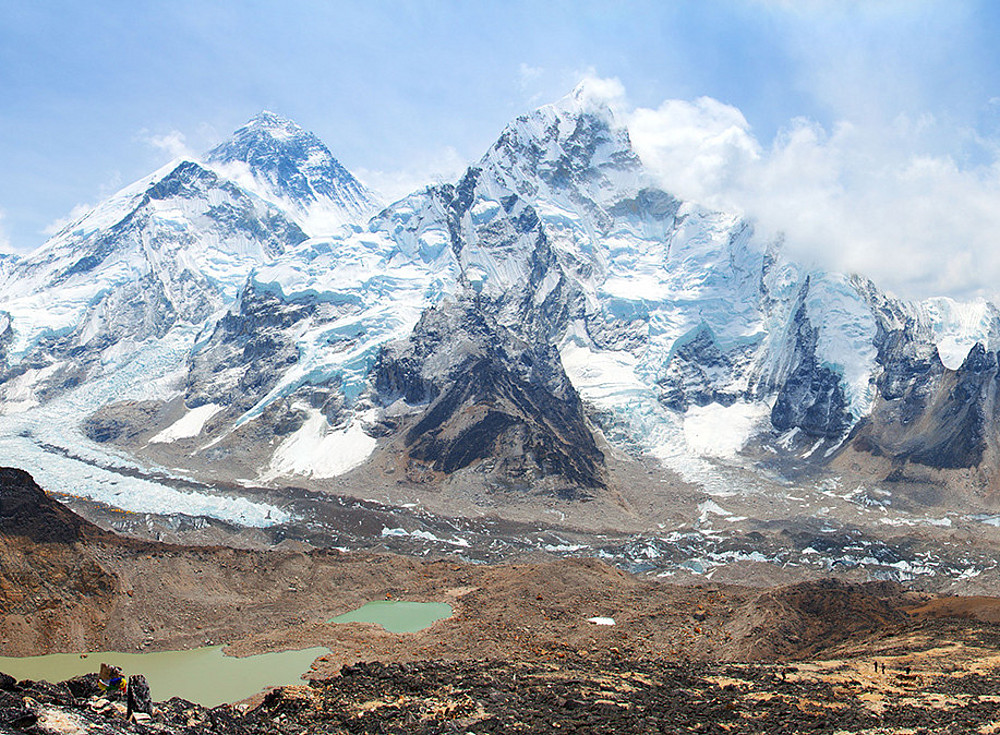
Panoramic view of the Khumbu Glacier in Nepal

Climate change is advancing more rapidly on the roof of the world than in lower-lying regions. A new study shows that snow and glacier melt could lead to natural disasters. Photo: Daniel Prudek/Adobe Stock

On average, the climate in the mountains warms up half as fast as in the lowlands. At the same time, precipitation and snow cover are decreasing to a greater extent. This is the conclusion reached by international researchers led by the University of Portsmouth in a recently published paper in the scientific journal Nature Reviews Earth & Environment. The changes in temperature and humidity cause flooding, landslides and droughts. "The effects on agriculture and forestry are much more serious than for winter tourism," summarises Jakob Steiner from the university's Department of Geography and Regional Sciences, who worked on the study. Probably the biggest problem in the near future - for Styria, among others - will be the increasing drought and the associated risk of forest fires.

For the current publication, the researchers compared around 200 international studies and analysed data from different regions of the world. On average, the air temperature at high altitudes rose by 0.02 degrees per year between 1980 and 2020, while precipitation fell by one millimetre overall and snowfall by almost three millimetres per year. The Rocky Mountains and the Asian high mountains are most affected by the change. As the temperature changes, so does the humidity, and the shrinking snow cover reduces the albedo effect - the reflection of solar radiation back into the atmosphere. This in turn leads to further warming of the Earth's surface.

Devastating consequences
The global effects of altitude-dependent climate change are serious: more than a billion people are dependent on water supplies from the Himalayas. Now that the ice there is rapidly disappearing, there is a threat of flooding on the one hand and drought on the other if there is no rainfall. More precise forecasts to better mitigate possible consequences are currently difficult: "We need more measurements above 2500 metres above sea level and smaller-scale models to better understand the changes in mountain regions. In any case, we all need to do more to combat global warming," summarises the researcher.
Publication:
Nick Pepin, Martha Apple, John Knowles, Silvia Terzago, Enrico Arnone, Lorenz Hänchen, Anna Napoli, Emily Potter, Jakob Steiner, Scott N. Williamson, Bodo Ahrens, Tanmay Dhar, A. P. Dimri, Elisa Palazzi, Arathi Rameshan, Nadine Salzmann, Maria Shahgedanova, João de Deus Vidal Jr., Dino Zardi: "Elevation-dependent climate change in mountain environments", Nature Reviews Earth & Environment

created by Dagmar Eklaude

Related news

Dagmar Henner 1969–2026

Dagmar war uns allen eine wunderbare Kollegin. Wir haben gemeinsam über Forschungsfragen nachgedacht, in Projekten gearbeitet, versucht, Antworten zu finden – für eine bessere Zukunft, für alle, die nach uns kommen. Wir denken an die Zeit mit Dagmar und verbleiben in tiefstem Respekt und mit großer Dankbarkeit.

ABGESAGT: URBI Science Talk

ABGESAGT Ein neuer Termin im Herbst wird noch bekanntgegeben.

Barbara Gasteiger-Klicpera bei STEIRERIN AWARDS nominiert

Barbara Gasteiger-Klicpera ist als einzige Wissenschaftlerin der Uni Graz in der Kategorie Wissenschaft & Technik bei den STEIRERIN AWARDS nominiert.

URBI Get Together - 12. März, ab 16 Uhr, Meerscheinschlössl

Begin of page section:
Additional information:

University of Graz
Universitaetsplatz 3
8010 Graz
Austria
  • Contact
  • Web Editors
  • Moodle
  • UNIGRAZonline
  • Imprint
  • Data Protection Declaration
  • Accessibility Declaration
Weatherstation
Uni Graz

End of this page section. Go to overview of page sections

End of this page section. Go to overview of page sections

Begin of page section:

End of this page section. Go to overview of page sections