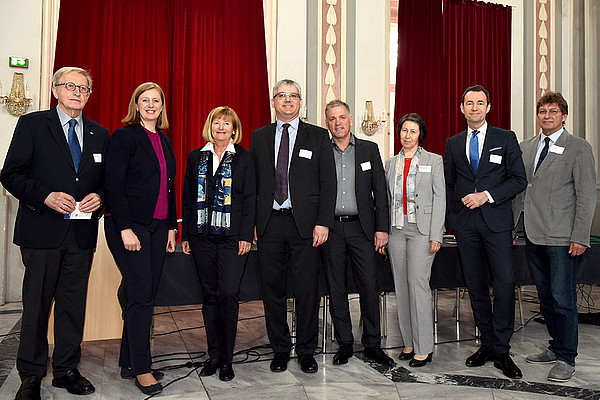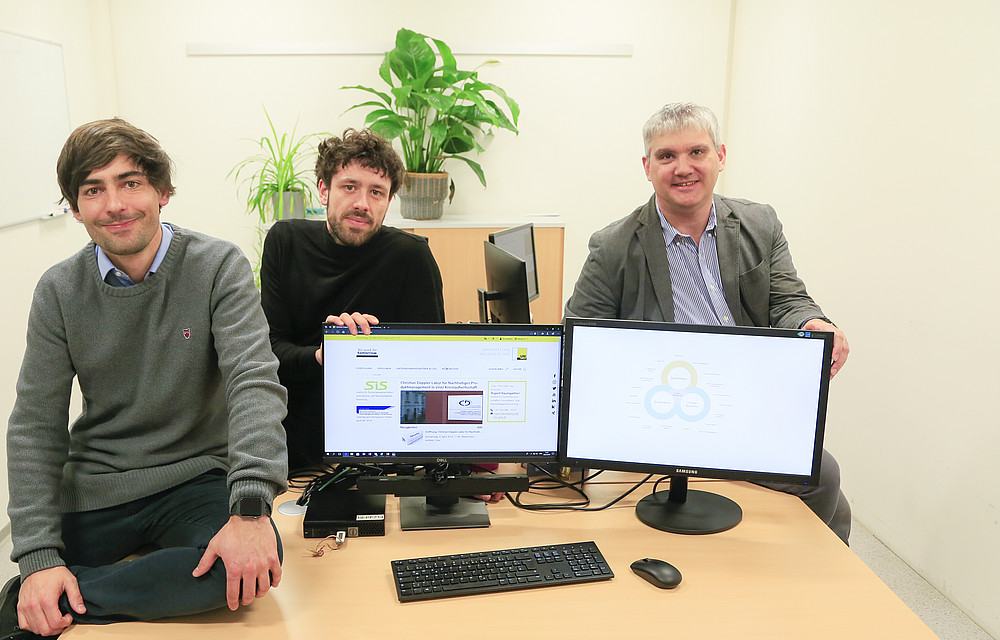
How sustainable is a product or a service? This is a question that is becoming increasingly important when deciding to purchase something. This is why companies are also considering how the products and services they offer can align with this demand more than ever before. However, what criteria allow them to reliably assess the ecological and social sustainability of a product for the duration of its life cycle and beyond? How can they collect the data required for this assessment? And how can the data be used appropriately so as to help companies decide on how to offer their products and services in a way that is socially and environmentally sustainable? The Christian Doppler Laboratory for Sustainable Product Management enabling a Circular Economy, which opens at the University of Graz on 4 April 2019, seeks to answer these questions with its research. The CD Laboratory is financed jointly by the participating companies and the Austrian Federal Ministry for Digital and Economic Affairs.
“The question is no longer simply whether we are using profits in a socially responsible way, but whether we are manufacturing and operating in a sustainable manner. In order to assess the sustainability of a product over its entire lifecycle, a large amount of data needs to be processed. The methods associated with digitalisation offer new opportunities in this respect too”, says Dr Margarete Schramböck, Austrian Federal Minister for Digital and Economic Affairs. “We can use this new knowledge to design products sustainably from the start. This is yet another way in which digitalisation can contribute to our society’s future stability and success.”
The concept of a circular economy is currently of great interest to the public. This refers to a system based on regeneration. Its goal is to reduce the use of resources, and to reduce emissions and waste. Possible options to achieve this could be for example through maintenance services, reusing, and recycling products. “However, this does not mean that a circular economy always fulfils the demands for social and ecological sustainability”, as sustainability researcher Rupert Baumgartner, the head of the new CD Laboratory at the University of Graz, points out.
Assessing the sustainability of a product such as a smartphone confronts us with a complex interrelationship of a wide variety of factors. The assessment begins with the extraction of raw materials in developing countries and the impact it has on the environment and on the socioeconomic situation of the people working there. Then the conditions under which it was produced have to be considered. Finally, a smartphone usually travels a great distance: e.g. from Asia to Europe. All along the journey, emissions are produced and energy is consumed. This does not stop even when the device’s life cycle has come to an end: the process usually just begins anew. Most of the ‘discarded’ smartphones end up back in the countries of the southern hemisphere, where the precious raw materials built into their components are recycled so that they can be reused again.
Developing a scientifically solid basis for sustainability assessments
Over the next few years, Rupert Baumgartner and his team wish to shed light on the convoluted web of global supply chains and to develop a scientifically solid basis for sustainability assessments of products and services in a circular economy. The CD Laboratory is working in collaboration with Altstoff Recycling Austria Aktiengesellschaft (ARA) and iPoint, a company which is active on the global market and offers software solutions and consultation services for sustainable product management.
Their research will begin by collecting information through surveys of companies wishing to develop in the direction of a circular economy; the focus lies on the automotive and packaging industries. “We would like to know what company data are collected that could be interesting for a sustainability assessment”, explains Josef Schöggl, a researcher at the CD Laboratory. He mentions the following examples: “energy consumption, emissions, the origin of raw materials, working conditions, waste, transport distances”. Another question to be answered is whether the information gathered thus far is sufficient or if important information still needs to be collected.
After determining which criteria a sustainable product has to fulfil, Baumgartner and his team will develop efficient methods for the collection, integration and analysis of the relevant data: “Digitalisation provides researchers with many new options. We will investigate what the Internet of Things and Big Data can do for us in terms of our goals.”
Ultimately, research should benefit the economy and, by extension, society as a whole in a practical way. “We hope the knowledge we acquire will provide a basis for the development of practical tools which can serve as a decision-making aid for companies wishing to achieve sustainable product management in a circular economy”, stresses Baumgartner.
About Christian Doppler Laboratories
In Christian Doppler Laboratories, application-oriented basic research is pursued at a high level, and expert scientists cooperate with innovative companies. The Christian Doppler Research Association is an international best practice example for promoting this collaboration. Christian Doppler Laboratories are financed jointly by the public purse and the participating companies. The most important public sponsor is the Federal Ministry for Digital and Economic Affairs (BMDW).