



Begin of page section:
Page sections:

  • Go to contents (Accesskey 1)
  • Go to position marker (Accesskey 2)
  • Go to main navigation (Accesskey 3)
  • Go to sub navigation (Accesskey 4)
  • Go to additional information (Accesskey 5)
  • Go to page settings (user/language) (Accesskey 8)
  • Go to search (Accesskey 9)

End of this page section. Go to overview of page sections

Begin of page section:
Page settings:

English en
Deutsch de
Search
Login

End of this page section. Go to overview of page sections

Begin of page section:
Search:

Search for details about Uni Graz
Close

End of this page section. Go to overview of page sections


Search

Begin of page section:
Main navigation:

Page navigation:

  • University

    University
    • About the University
    • Organisation
    • Faculties
    • Library
    • Working at University of Graz
    • Campus
    Developing solutions for the world of tomorrow - that is our mission. Our students and our researchers take on the great challenges of society and carry the knowledge out.
  • Research Profile

    Research Profile
    • Our Expertise
    • Research Questions
    • Research Portal
    • Promoting Research
    • Research Transfer
    • Ethics in Research
    • Commission for Scientific Integrity
    Scientific excellence and the courage to break new ground. Research at the University of Graz creates the foundations for making the future worth living.
  • Studies

    Studies
    • Prospective Students
    • Students
    • Welcome Weeks for First Year Students
  • Community

    Community
    • International
    • Location
    • Research and Business
    • Alumni
    The University of Graz is a hub for international research and brings together scientists and business experts. Moreover, it fosters the exchange and cooperation in study and teaching.
Topics
  • Sustainable University
  • Researchers answer
  • Work for us
Close menu

End of this page section. Go to overview of page sections

Begin of page section:
You are here:

University of Graz Faculty of Environmental, Regional and Educational Sciences Neuigkeiten Researchers document glacier retreat with aerial photographs from the time of the occupation
  • About the Faculty
  • Study services
  • Our research
  • Dean's Office
  • Neuigkeiten

End of this page section. Go to overview of page sections

Monday, 16 December 2024

Researchers document glacier retreat with aerial photographs from the time of the occupation

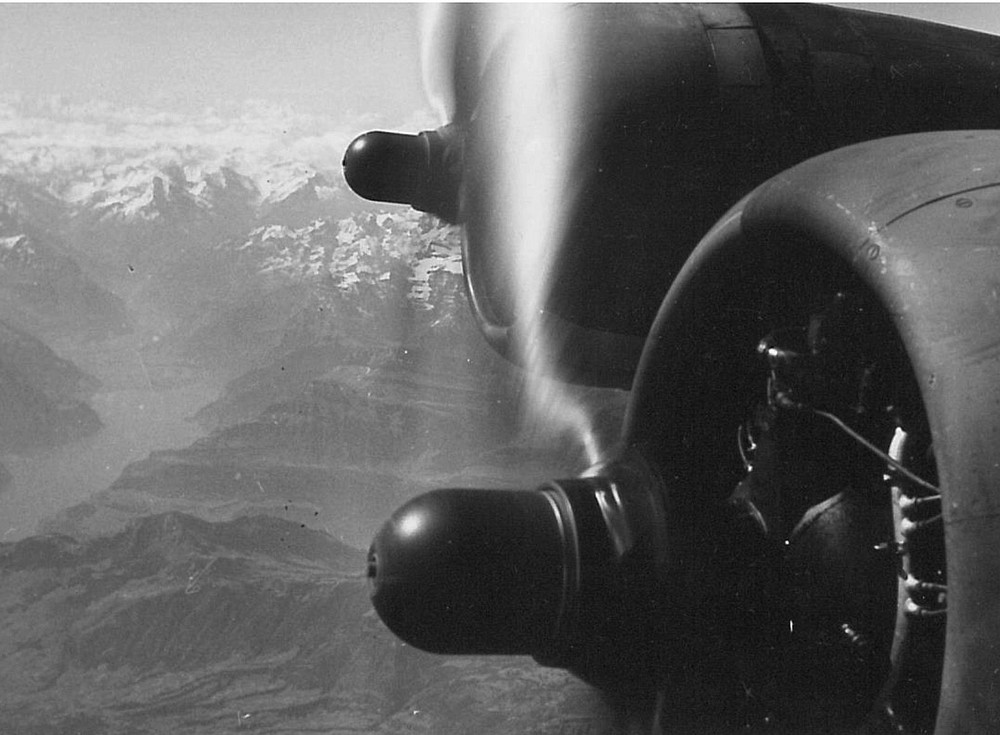
historical view of the Alps from a US Air Force aircraft

A new interpretation of the view from above: Researchers in Graz use aerial photographs from the time of the occupation to survey the glaciers. Photo: BAR E27/22042, report by the "Fliegerequipe der Landestopographie"

Immediately after the end of the Second World War, the US Air Force still had a number of fighter planes stationed in Europe. Instead of withdrawing them, they were used for a mapping project with the primary aim of documenting the efficient destruction using images. A research team from Graz, led by glaciologist Jakob Abermann, is now using these archive images to survey the glaciers of the time.

"The 1940s are particularly interesting for us because it was also relatively warm back then and the snow line was therefore very high in summer," reports Jakob Abermann from the Institute of Geography and Spatial Research at the University of Graz. "In addition, the historical aerial photographs offer the unique opportunity to analyse the glaciers over a large area." Until now, there have only been spot surveys of individual ice fields. Together with his project team, he managed to acquire copies of the images. A first glance at the documents clearly shows the disintegration of larger glaciers into small, almost static ice fields. The researchers also identified a number of newly formed lakes and changes in river courses.

"We see it as our social responsibility not to let this treasure trove of data lie dormant in archives, but to process it," says Abermann. Tobias Bolch, an expert in analysing historical aerial photographs at Graz University of Technology, has already scanned the first images. "It's amazing what high quality was achieved back then. It's high time we had detailed information on an important point in the history of the high mountains," emphasises the researcher.
In a further step, the changes in glacier areas and volumes since the Little Ice Age around 1850 will be analysed and interpreted climatologically. The results should be available in four years and made publicly accessible via Austrian mapping services.

The project is funded by several federal states, the Federal Ministry of Agriculture, Forestry, Regions and Water Management, the Austrian Academy of Sciences and the Universities of Graz, Innsbruck and Graz University of Technology.

created by Dagmar Eklaude

Related news

Dagmar Henner 1969–2026

Dagmar war uns allen eine wunderbare Kollegin. Wir haben gemeinsam über Forschungsfragen nachgedacht, in Projekten gearbeitet, versucht, Antworten zu finden – für eine bessere Zukunft, für alle, die nach uns kommen. Wir denken an die Zeit mit Dagmar und verbleiben in tiefstem Respekt und mit großer Dankbarkeit.

ABGESAGT: URBI Science Talk

ABGESAGT Ein neuer Termin im Herbst wird noch bekanntgegeben.

Barbara Gasteiger-Klicpera bei STEIRERIN AWARDS nominiert

Barbara Gasteiger-Klicpera ist als einzige Wissenschaftlerin der Uni Graz in der Kategorie Wissenschaft & Technik bei den STEIRERIN AWARDS nominiert.

URBI Get Together - 12. März, ab 16 Uhr, Meerscheinschlössl

Begin of page section:
Additional information:

University of Graz
Universitaetsplatz 3
8010 Graz
Austria
  • Contact
  • Web Editors
  • Moodle
  • UNIGRAZonline
  • Imprint
  • Data Protection Declaration
  • Accessibility Declaration
Weatherstation
Uni Graz

End of this page section. Go to overview of page sections

End of this page section. Go to overview of page sections

Begin of page section:

End of this page section. Go to overview of page sections