



Begin of page section:
Page sections:

  • Go to contents (Accesskey 1)
  • Go to position marker (Accesskey 2)
  • Go to main navigation (Accesskey 3)
  • Go to sub navigation (Accesskey 4)
  • Go to additional information (Accesskey 5)
  • Go to page settings (user/language) (Accesskey 8)
  • Go to search (Accesskey 9)

End of this page section. Go to overview of page sections

Begin of page section:
Page settings:

English en
Deutsch de
Search
Login

End of this page section. Go to overview of page sections

Begin of page section:
Search:

Search for details about Uni Graz
Close

End of this page section. Go to overview of page sections


Search

Begin of page section:
Main navigation:

Page navigation:

  • University

    University
    • About the University
    • Organisation
    • Faculties
    • Library
    • Working at University of Graz
    • Campus
    Developing solutions for the world of tomorrow - that is our mission. Our students and our researchers take on the great challenges of society and carry the knowledge out.
  • Research Profile

    Research Profile
    • Our Expertise
    • Research Questions
    • Research Portal
    • Promoting Research
    • Research Transfer
    • Ethics in Research
    • Commission for Scientific Integrity
    Scientific excellence and the courage to break new ground. Research at the University of Graz creates the foundations for making the future worth living.
  • Studies

    Studies
    • Prospective Students
    • Students
    • Welcome Weeks for First Year Students
  • Community

    Community
    • International
    • Location
    • Research and Business
    • Alumni
    The University of Graz is a hub for international research and brings together scientists and business experts. Moreover, it fosters the exchange and cooperation in study and teaching.
Topics
  • Sustainable University
  • Researchers answer
  • Work for us
Close menu

End of this page section. Go to overview of page sections

Begin of page section:
You are here:

University of Graz Faculty of Environmental, Regional and Educational Sciences Neuigkeiten From the morning circle to the bedtime story: Why toddlers need rituals
  • About the Faculty
  • Study services
  • Our research
  • Dean's Office
  • Neuigkeiten

End of this page section. Go to overview of page sections

Monday, 30 September 2024

From the morning circle to the bedtime story: Why toddlers need rituals

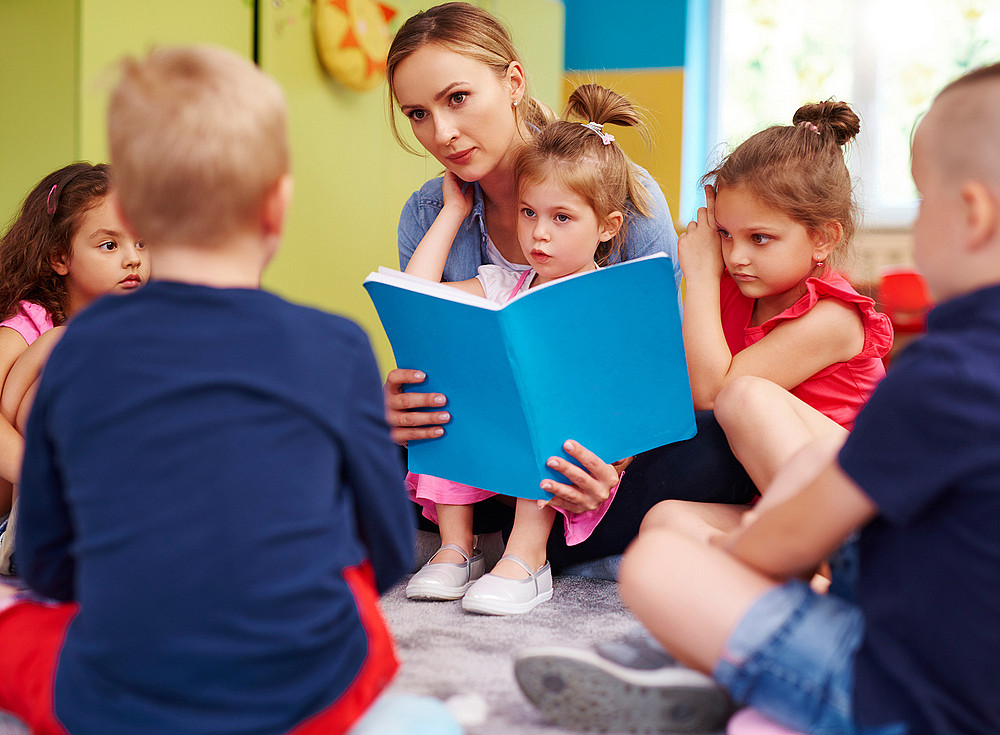
Kindergarten children sit in a circle on the floor, a woman reads from a book ©Gpointstudio - stock.adobe.com
©Gpointstudio - stock.adobe.com

Rituals, such as reading a story every day, give children security, structure and orientation. Photo: Gpointstudio - stock.adobe.com

There is a vase of flowers on the small table in the entrance area of the kindergarten, with a photo of Manuel next to it. This makes it clear to everyone: today is Manuel's birthday! Every child finds their picture on this table next to a small bouquet once a year. Elementary pedagogue Catherine Walter-Laager explains why rituals like this are important for children.

The birthday ritual is an integral part of elementary education. "It is a visible marker for everyone, a stop in the course of the year. It provides structure and orientation," says Catherine Walter-Laager, describing one of its functions. "It's also important that it's the same for everyone. Every child is recognised in the same way and knows what to expect. This provides security," adds the researcher.

All rituals have something in common: they are repeated over and over again and always take place in the same way. Regardless of whether it's daily, like the morning circle in kindergarten, or once a year, like the lantern festival in November. The list could go on and on.

Fixed, playful routines can also be a great help for parents in everyday life, in the sense of agreements, says Walter-Laager and gives an evening ritual as an example: "I'll read you a bedtime story and then switch off the light. That way, there's no need to renegotiate bedtime every day."

Isn't that getting boring? Not as long as there is still a fundamental openness. "Ritualising everything would mean blocking the opportunity to learn new things, experience diversity and develop creative strategies," emphasises the elementary pedagogue. Fixed routines are not always and everywhere appropriate. "When conflicts arise, for example, it is important to engage in dialogue in order to understand each other and find a suitable solution, depending on the situation," explains Walter-Laager. Simply ritually apologising and shaking hands to end the conflict would be wrong here.

created by Gudrun Pichler

Related news

Dagmar Henner 1969–2026

Dagmar war uns allen eine wunderbare Kollegin. Wir haben gemeinsam über Forschungsfragen nachgedacht, in Projekten gearbeitet, versucht, Antworten zu finden – für eine bessere Zukunft, für alle, die nach uns kommen. Wir denken an die Zeit mit Dagmar und verbleiben in tiefstem Respekt und mit großer Dankbarkeit.

ABGESAGT: URBI Science Talk

ABGESAGT Ein neuer Termin im Herbst wird noch bekanntgegeben.

Barbara Gasteiger-Klicpera bei STEIRERIN AWARDS nominiert

Barbara Gasteiger-Klicpera ist als einzige Wissenschaftlerin der Uni Graz in der Kategorie Wissenschaft & Technik bei den STEIRERIN AWARDS nominiert.

URBI Get Together - 12. März, ab 16 Uhr, Meerscheinschlössl

Begin of page section:
Additional information:

University of Graz
Universitaetsplatz 3
8010 Graz
Austria
  • Contact
  • Web Editors
  • Moodle
  • UNIGRAZonline
  • Imprint
  • Data Protection Declaration
  • Accessibility Declaration
Weatherstation
Uni Graz

End of this page section. Go to overview of page sections

End of this page section. Go to overview of page sections

Begin of page section:

End of this page section. Go to overview of page sections